
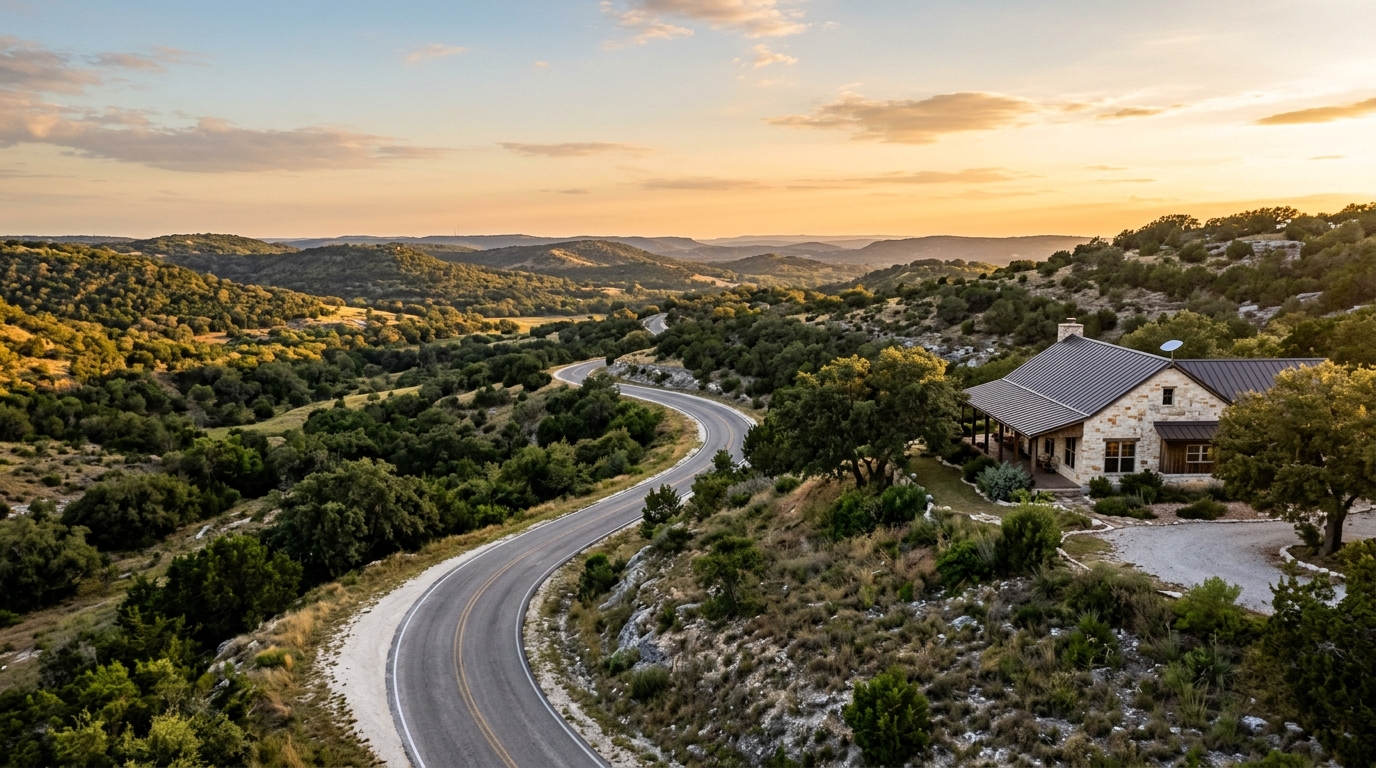
Three questions came up at showings last week, all from remote workers, and the honest answers I gave.
The first one is always internet. Always. People tour a place off a county road outside Spring Branch, fall in love with the live oaks and the limestone, and then ask me — sort of casually, like it's an afterthought — how the internet is out here. It's not an afterthought. It's the deal. I've watched two contracts die in the last six months because the buyer assumed they'd figure it out after closing and then found out the only option at the address was a fixed wireless tower with line-of-sight problems and 12 Mbps on a good day.
So here's what I tell people now, before we even pull up to a property.
Check the address on the FCC broadband map and check it against the actual provider. Not the marketing map. The provider's serviceability tool, with the exact 911 address typed in. GVTC covers a real chunk of Comal County with fiber and they're the gold standard out here — if you can get GVTC fiber, you've basically got San Antonio-grade service in the woods. Spectrum cable reaches more of the populated corridors than people assume, including a lot of Bulverde and the developed parts off 281. AT&T fiber is hit or miss and expanding, but "expanding" doesn't help you on a Tuesday standup.
If none of those hit your address, you're looking at Starlink, T-Mobile or Verizon home internet on a cell signal, or a fixed wireless WISP. Starlink works. I've got clients on it deep in Blanco County running full-time remote jobs with two kids on Zoom school and they're fine. The catch is the dish needs sky — actual sky, not sky filtered through a 60-foot live oak canopy — and a lot of Hill Country lots are covered in canopy. That's part of why you bought it. Now it's a problem.
The unexpected detail I'd give anyone moving out here: drive the property at the time of day you actually work, with your phone on the carrier you actually use, and run a speed test. Then drive 200 feet down the road and run it again. Coverage shifts that fast out here because of the terrain. The hills that make the views are the same hills that block the signal.
The coworking question
Second question I get is whether there's anywhere to go when the house feels small. The honest answer is: less than you'd hope, more than there used to be.
New Braunfels has a few real options and the coffee shop scene has gotten serviceable for a working day — Naegelin's is a bakery, not a coworking spot, but a few of the newer places off Gruene Road will let you camp for hours with decent wifi. Boerne has Soulshine and a couple of others that work in a pinch. Canyon Lake is thin. Like, real thin. If you live on the north side of the lake and need a desk that isn't your kitchen table, you're driving to New Braunfels or Bulverde, and that's a 30-40 minute drive depending on which arm of the lake you're on and what FM 306 is doing that morning.
If a true office environment matters to you more than a couple of days a week, factor that drive into where you buy. I've had buyers pick a house in Bulverde over one they liked better in Canyon Lake purely because the Bulverde one was 12 minutes from a coworking space they could walk into without thinking about it. That's a legitimate reason to weigh location. Don't let anyone tell you it isn't.
Third question, and this one's tied to money: is now the time to buy, or wait?
I'm not going to tell you what rates are doing. Nobody knows. But I will tell you what the market looks like as of this spring. New Braunfels closed April 2026 at a median of $399,990 per Movoto's market data. Austin's median held flat year-over-year at $445,000 in April per the Austin Housing Forecast — that's after almost four years of declines, which is the part worth paying attention to. Fredericksburg's a more interesting case: in-town active list prices are up 14% to $462,000 while Q1 closed sales were down 8.8% according to the April 2026 market report from Fore Premier Properties. That's a gap between what sellers want and what buyers are doing, and gaps like that are where you negotiate.
If you're remote and you're not tied to a school district or a commute, you've got more leverage than a local buyer. You can look at Spring Branch, Blanco, the back side of Canyon Lake, the FM 32 stretch — places a San Antonio commuter can't really use but you can. The properties that sit longest are the ones too far from anything for a normal buyer. Those are your properties. That's the play.
The thing I'd defend at a BBQ
Buy for the internet first and the view second. I know that sounds backwards. The view is why you're moving out here. But you can fix a lot of things on a property — you can clear cedar, you can re-roof, you can remodel a kitchen — and you cannot fix the fact that fiber doesn't run down your road and the nearest tower has a hill between it and your office.
I've seen people spend $700K on a place and then spend another $1,500/month on bonded cellular setups and Starlink with a backup WISP because they didn't check before closing. That money would've bought them a different house with fiber at the curb.
Two practical things you can do today: pull up the FCC National Broadband Map, type in the address, and write down every provider listed. Then call those providers directly with the exact address and ask for serviceability — not availability in the area, serviceability at the address. Get a confirmation number. Marketing maps lie. Confirmation numbers don't.
If you want to actually look at properties with this filter applied, you can search at collab-rt.com or just text me an address and I'll tell you what's there before you drive out.
What's your question? Send it. I'll answer the next round next month.
Data sourced from Movoto New Braunfels market trends (April 2026), Austin Housing Forecast (April 2026), and the Fore Premier Properties April 2026 market report. Verify current numbers with a local agent before acting.
Leave a Comment