
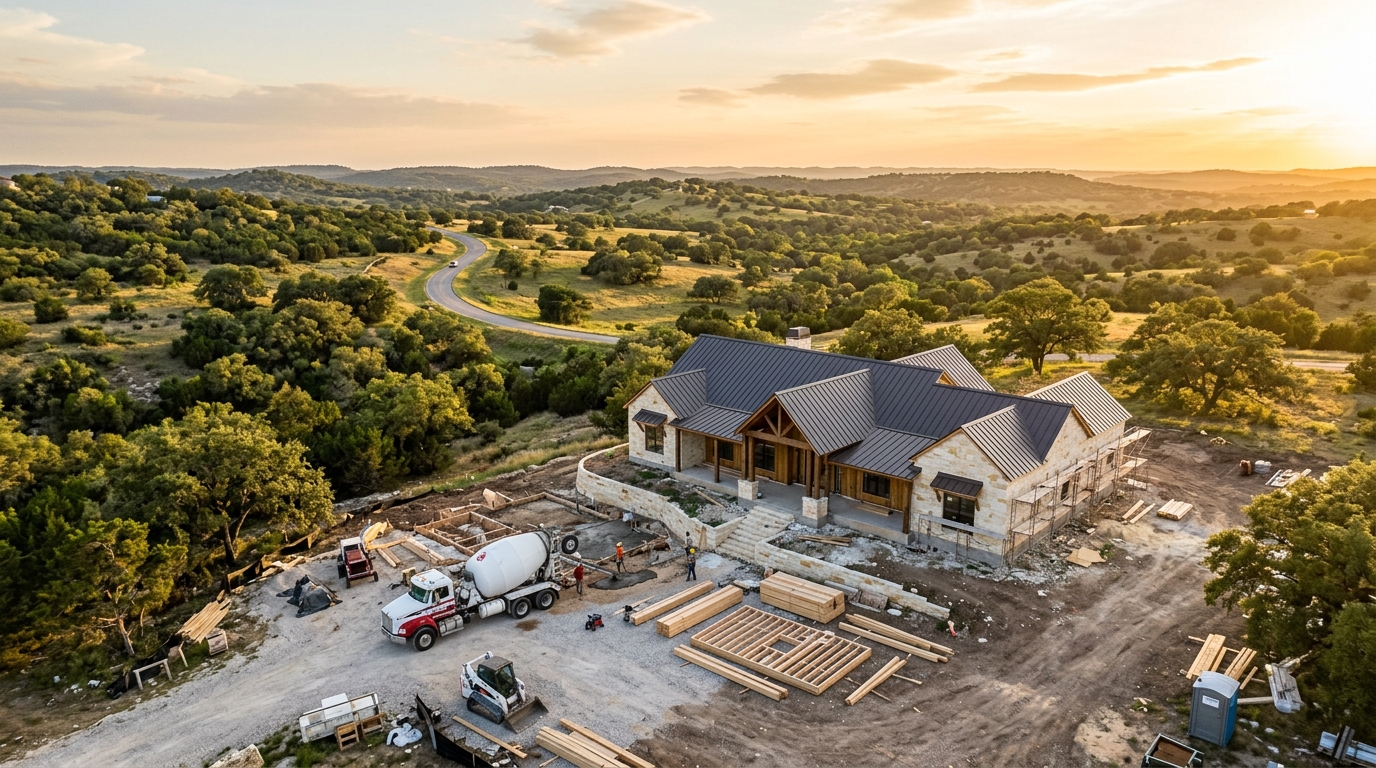
Land in the Austin–Waco–Hill Country region hit a record $8,040 per acre in Q2 2026, up 8.63% year over year, per the Texas Real Estate Research Center's Q2 2026 land report. The rest of Texas went flat. We didn't.
That number is where every custom home budget in this part of the world actually starts, and most people I sit down with have no idea. They're pricing the house. They forgot the dirt is doing its own thing.
So let me walk through what a real 2026 build looks like, line by line, using numbers I'm actually seeing this month on jobs between Bulverde, Spring Branch, and Canyon Lake.
The dirt
Call it 5 acres to keep the math clean. At $8,040/acre you're already at $40,200 for raw land at the regional median — and median means half the parcels cost more. Anything with a view, road frontage, or a decent building envelope is running $15k–$25k an acre right now around Bulverde and the 281 corridor. Bulverde's median home price is $1,052,450 as of July 2026 (up 66.2% year-over-year per the Texas Hill Country Housing Market Update). That's not a typo. That's what's happening on the ground.
Then you clear it. Caliche and Ashe juniper don't move themselves. Budget $4,000–$12,000 per acre depending on tree density, how much you're saving, and how far the burn pile has to travel. I've had jobs where the clearing bill came in higher than the survey, the septic design, and the driveway combined.
Water, septic, power
This is where people's eyes get big.
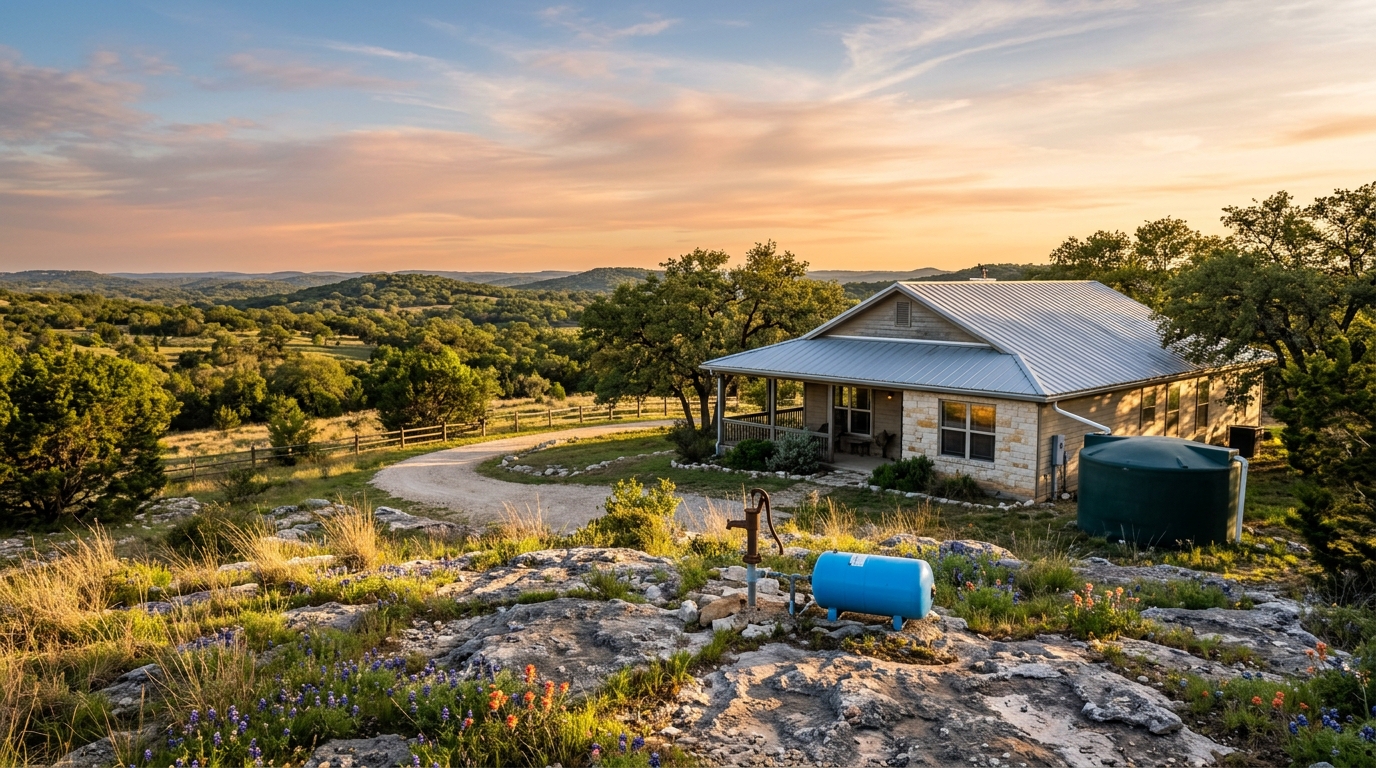
A residential well in this region runs $18,000 to $35,000+ for a complete system, per the 2026 well drilling cost guide for Texas Hill Country. We're drilling through Edwards Plateau limestone at 500–1,400 feet, and if you hit karst you're paying for it. Add a softener because the water is hard enough to chew — figure another $3,500–$6,000 installed.
Septic isn't cheap either. If you're in an aerobic-required zone (most of Comal and Kendall aquifer areas are), you're looking at $10,000–$20,000 to install, plus $600–$900 a year in mandatory quarterly inspections and the two-year maintenance contract. Permits themselves are small money — $200–$500 in Comal and Kendall — but the system behind the permit is not.
Electric service to a lot that isn't already stubbed can run anywhere from $3,500 for a short pole run to $40,000+ if the co-op has to trench any real distance. Get the quote before you close on the land. I mean it. I've watched buyers find out about a $28,000 line extension after the earnest money went hard.
The house itself
Here's where I'm going to get flat with you. Anyone quoting you $200/sf for a custom home in the Hill Country in 2026 is either lying, cutting corners, or building a barndominium with drywall stapled to the studs.
Real numbers for a real custom build right now:
$285–$325/sf for a straightforward build. Slab, framed, standard finishes, nothing weird with the roofline, no crazy site work.
$350–$425/sf for what most of my clients actually want. Native limestone accents, standing-seam metal roof, real wood beams, deep porches, higher-end kitchen and primary bath, engineered post-tension slab designed for the specific karst profile of your lot.
$500+/sf when we get into the Refined Regionalism stuff — Sisterdale limestone exterior, timber-frame porches, real stone masonry that references what you'd see at Vereins Kirche in Fredericksburg. It's not cheap. It's also the stuff that holds its value when the market breathes funny.
Two things buyers consistently underestimate. First, the foundation. Post-tension slabs engineered for your specific fractured limestone profile aren't optional here — they're the difference between a house and a $20,000+ repair bill five years in. Second, the porches. Everyone wants the wraparound deep-shade porch. Nobody budgets for it. That's another 400–800 square feet at close to house-level pricing.
Where the all-in lands
Pull it together for a 2,800 sf house on 5 acres, mid-tier finishes, well and aerobic septic, moderate site work:
Land: $75,000 (5 acres, better-than-median lot)
Clearing and site prep: $35,000
Well + softener: $28,000
Aerobic septic: $15,000
Utility connections: $12,000
Driveway (400 ft, base + chip seal): $18,000
House at $375/sf: $1,050,000
Design, engineering, permits, survey: $35,000
Landscape (native, drought-tolerant, because your topsoil is 3 inches deep over rock): $22,000
That's roughly $1.29M all-in before you buy a single stick of furniture. And I built that budget conservative. Add a pool, a shop, or a second-story primary and you're at $1.5M without breaking a sweat.
The reason Bulverde's median crossed a million is not because builders got greedy. It's because this is what it costs.
The play
Two decades of foundation pours out here and the same mistake keeps repeating: people budget for the house, then get blindsided by everything around the house. Land, water, septic, driveway, and site prep can easily add up to 25–30% of your total spend before framing starts. If your builder isn't itemizing those separately in the initial conversation, that's your first red flag.
The opportunity in this market: inventory sits at 11.0 months in Canyon Lake and 9.7 months in Spring Branch, and both markets are down year-over-year on median price. There are existing custom homes on 3–10 acres sitting on the market right now for less than it would cost to replicate them from scratch. I'm not saying don't build. I'm saying do the math on both paths before you commit. Sometimes the deal is already sitting there with a For Sale sign in front of it. We help clients run those side-by-side numbers through Parker Design and Consulting before they sign a construction contract, because a $40,000 design fee is a lot cheaper than a $200,000 mistake.
Get the well quote, get the septic design bid, get the utility extension estimate — all three — before you buy the land. Not after. Every horror story I've seen out here starts with somebody skipping that step.
Data sourced from the Texas Real Estate Research Center Q2 2026 land report, the Texas Hill Country Housing Market Update July 2026, and the 2026 Texas Well Drilling Cost Guide. Verify current numbers with a local agent before acting.

Leave a Comment