If you own a home outside city limits in the Hill Country, you have a septic system, and you probably haven't thought about it since closing. That's the problem.
I've been building custom homes out here for two decades and the septic call is the one I get from past clients more than any other single item. Not the roof. Not the HVAC. Septic. Usually three years in, usually a Sunday, usually because nobody pumped it.
Here's the short version of what you need to know, in the order it matters.
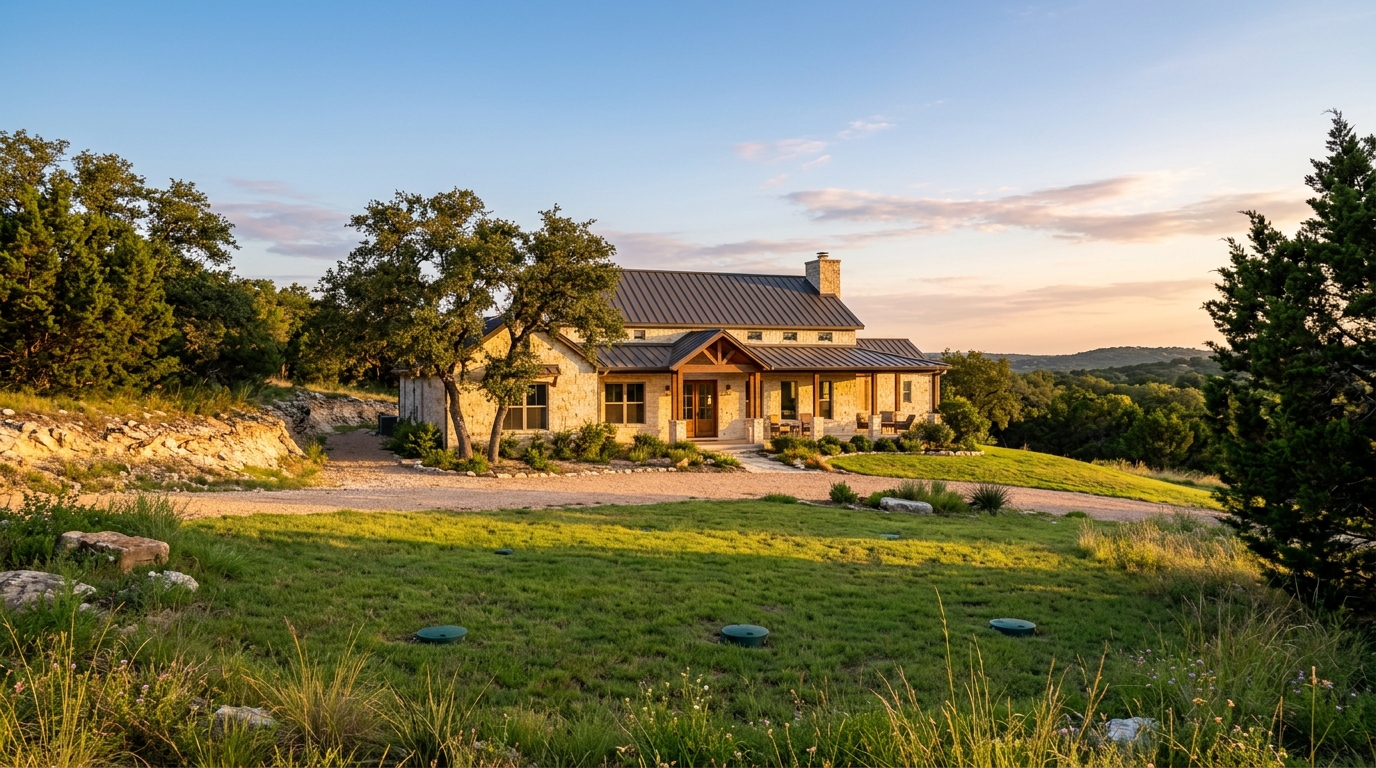
Know which system you actually have. Two flavors out here. Conventional gravity systems drain to a leach field and work when the soil cooperates. Most Hill Country lots don't have that soil. Between the caliche and the shallow limestone, a lot of properties won't perc, so you end up with an aerobic system — the one with the pump, the sprinkler heads, and the little alarm box on the side of the house that will start beeping at 2 a.m. eventually. If you don't know which one you have, walk your yard. If you see spray heads that look like irrigation but aren't tied to your sprinkler controller, that's your septic spraying treated effluent onto your grass. Yes, really.
Aerobics require a maintenance contract by state law. Not optional. TCEQ rules require the homeowner to keep an active contract with a licensed maintenance provider on any aerobic system, and inspections happen three times a year. A lot of new owners find out about this rule when the county sends them a notice. Budget $300–$500 a year for the contract, plus pumping every 3–5 years on top of that.
Pumping is the thing everyone skips. Don't skip it.
Call A-1 National Septic Pumping & Repair or Texas Septic Solutions if you're out toward Boerne, Fredericksburg, or Kerrville — both handle the whole Hill Country and both will tell you the same thing I'm telling you now, which is that a $400 pump-out every four years is dramatically cheaper than a $12,000 drainfield replacement when your tank overflows and pushes solids into the field lines.
Know your permit costs before you buy raw land. This one buyers miss constantly. A septic permit in Gillespie County runs $500 to over $1,000 depending on the system, and the required site evaluation and design will add another $800 to $2,000 before you've broken ground. On a lot that won't perc — and plenty out toward Enchanted Rock and up 281 don't — you're looking at an aerobic install in the $12,000–$18,000 range on top of everything else. If you're pricing land and forgetting septic, you're pricing wrong. Comal, Kendall, Hays, and Gillespie all have their own fee schedules and their own inspectors. Call the county before you write the offer, not after.
A few things that will kill a system faster than anything else: flushable wipes (they aren't), grease down the kitchen sink, a water softener discharging into the tank, and anyone in the house who thinks bleach is a cleaning strategy. The bacteria in the tank is doing the work. Stop killing it.
One more, because it comes up every summer. If your aerobic sprays onto Bermuda and you're in a burn ban or drought stage, that spray field is still legal to run — it's treated wastewater, not potable irrigation. Neighbors will occasionally get confused about that. Point them to the county.
Pump it. Contract it. Don't flush stupid things. That's 90% of septic ownership out here.
Data sourced from Gillespie County permit fee schedules and TCEQ Chapter 285 on-site sewage facility rules. Verify current numbers with your county environmental health office before acting.
Leave a Comment