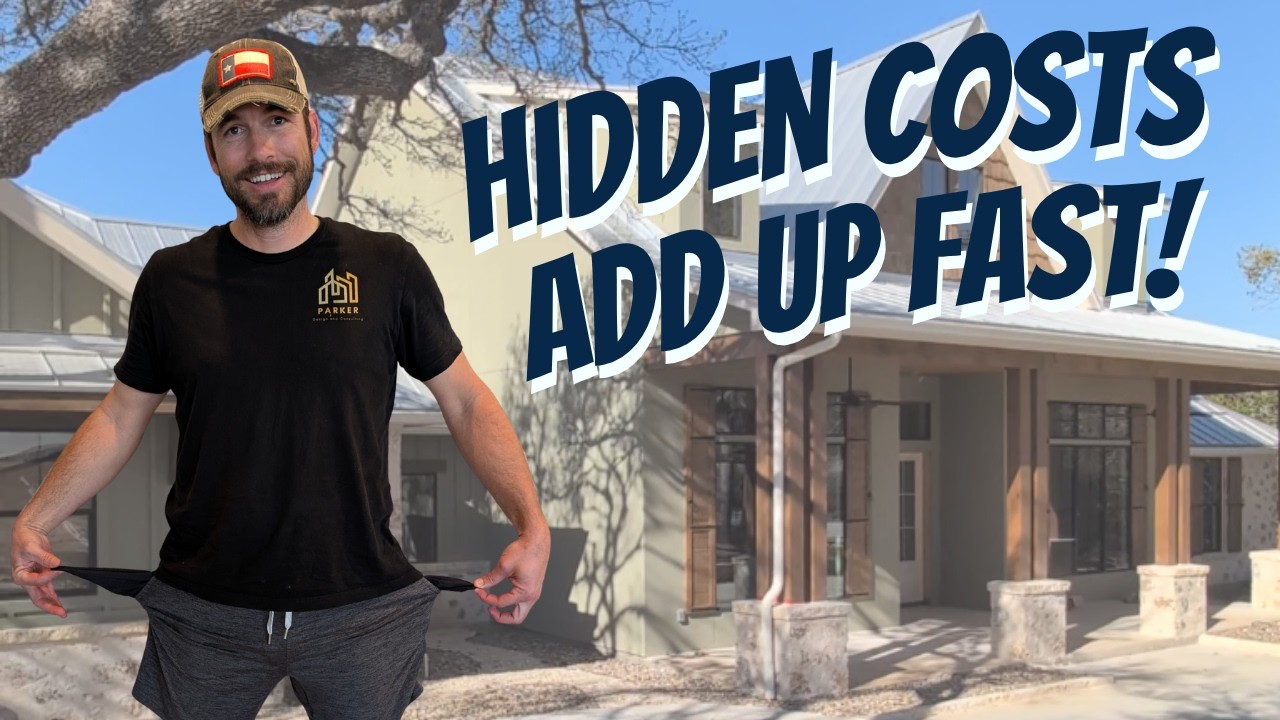
I get asked the same question at least three times a week: "Ryan, what does it actually cost to build a house out here?" And look, I wish I could give you a nice, clean number that fits on a business card, but that’s just not how it works in the Texas Hill Country. If you’re looking at those national websites or those 'budget builder' ads from three years ago, you’re setting yourself up for a massive headache. Most people find a piece of land they love, start picking out floor plans, and then realize they’re $100,000 over budget before they’ve even cleared a single cedar tree.
I've built over 400 homes. I own Parker Design & Consulting, and I spend my days helping people figure out if a lot is a dream or a financial nightmare. In 2026, the numbers have shifted again. It’s not just inflation — it’s the reality of building on top of solid limestone and trying to get a driveway up a 15-degree slope. Let's talk about what's actually happening on the ground.
How much is the cost per square foot in 2026?
Let's get the big number out of the way first. But keep in mind, this is for the house itself. This does not include your land, your well, or your septic. If you're building a "builder-grade" home — think standard finishes, basic siding, nothing fancy — you’re looking at $200 to $250 a foot. It's solid, it works, but it's not going to win any design awards.
Most of the folks I work with in Spring Branch or Canyon Lake want something more "mid-range custom." We're talking nicer cabinets, a better layout, and materials that don't look like they came off a clearance rack. For that, you’re looking at $250 to $280 per square foot. If you want the high-end stuff — massive windows to catch those views, premium stone, vaulted ceilings with reclaimed beams — you’re starting at $280 and there is truly no ceiling on that number. I've seen it go way higher when someone decides they need a kitchen that looks like a professional restaurant.
Why does the land price never tell the whole story?
This is where I see people get into real trouble. You’ll see two lots for sale in Bulverde or New Braunfels. Both are $150,000. One is flat and boring. The other has a "breathtaking" view of the valley but looks like a goat path. Guess which one is more expensive? The goat path. Every single time.
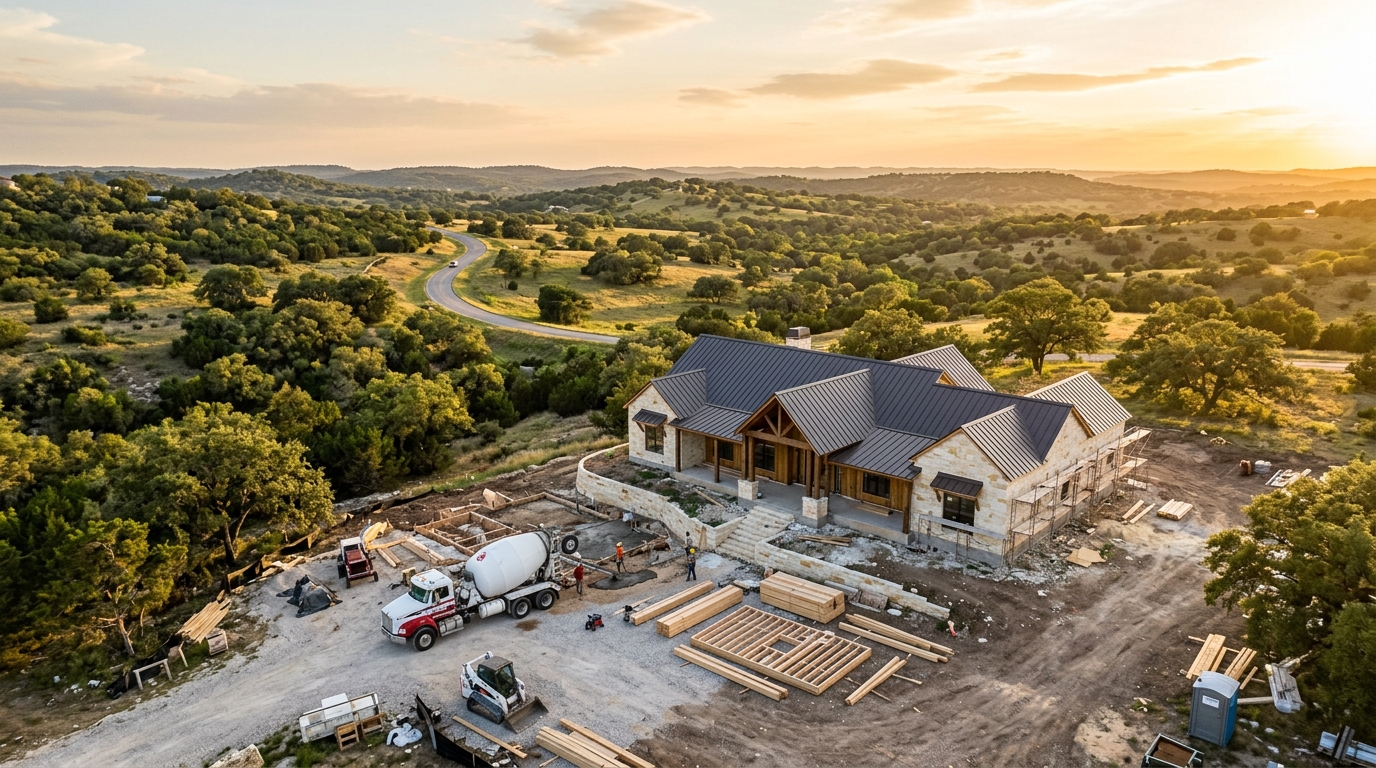
In the Hill Country, we have what I call the "view tax." That pretty slope means you're going to spend a fortune on retaining walls, extra concrete for a taller foundation, and specialized drainage so your house doesn't turn into a dam when the rain hits. I’ve seen site prep on a "cheap" lot cost $60,000 more than a flat lot. So, that $150,000 lot just became a $210,000 lot. And that's before you've even bought a doorknob. This is why I tell people to let me walk the land with them before they sign the papers. I'd rather tell you it’s a bad idea now than watch you go broke later.
The "Hidden" costs that blow every budget
Rock Excavation: We live on a giant rock. If you need to dig a trench for a utility line and you hit solid limestone, the price goes up. Trenching through rock is about $12 to $15 per foot. If your house is set back 200 feet from the road, do the math. It’s not pretty.
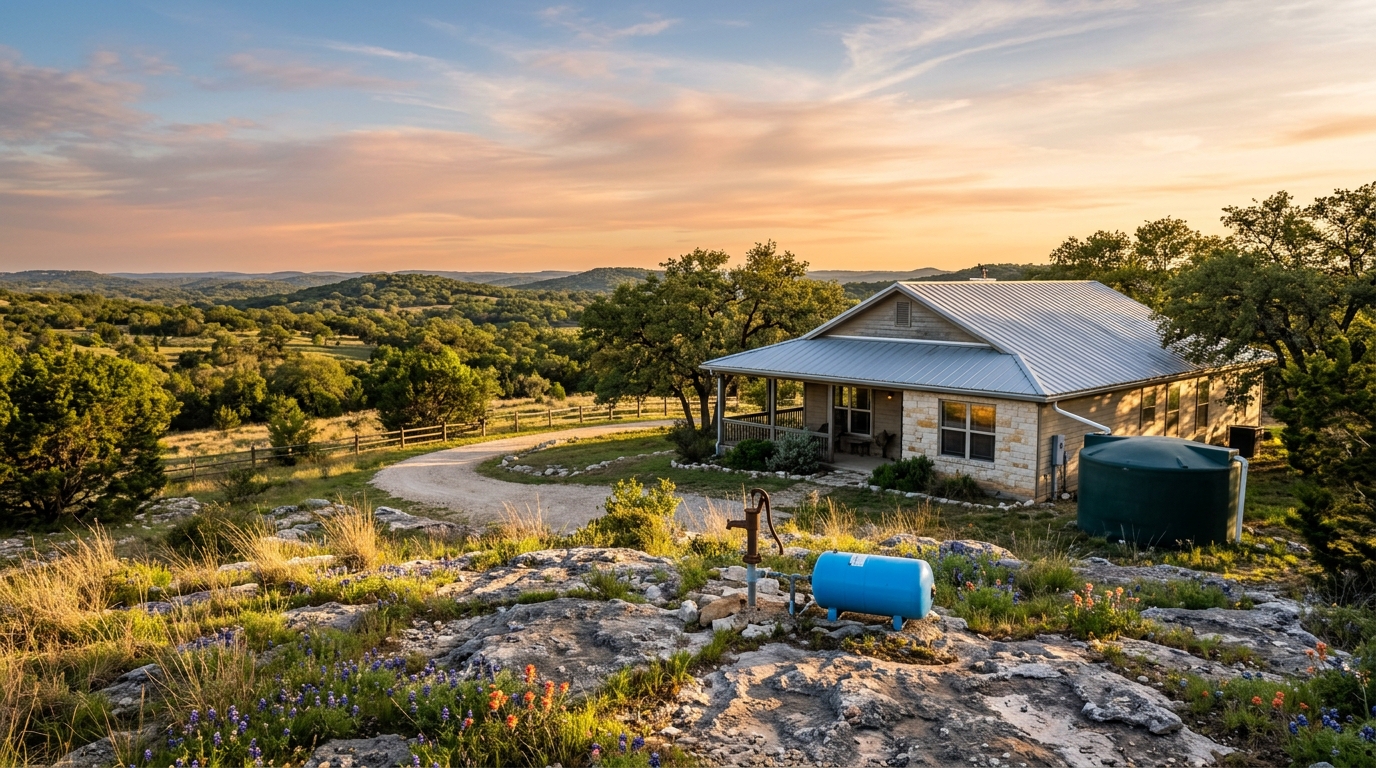
Utilities: If you’re building in a rural area, you’re the utility company. A well can run you $40,000. A septic system is another $12,000 to $15,000. And if you want propane? A buried tank is about $6,000.
The HVAC Reality: This one is wild. HVAC costs have basically doubled in the last few years. A 3,000-square-foot house that used to cost $15,000 to cool now costs $25,000 or $30,000. Don't use old quotes. They're useless.
Driveways: A "standard" driveway sounds cheap until you realize yours is 150 feet long and needs a backup pad. You can easily drop $20,000 on a driveway and not even have it be "fancy" concrete.
Thinking about making the jump to the area? Grab my Free Hill Country Relocation Guide to see where the best spots are and what you’re actually getting into.
What about the "Allowance Overage" trap?
I see this on almost every build. We set a budget for "allowances" — things like lighting, countertops, and appliances. You go to the showroom and see a faucet that’s $50 more than the one in the budget. "It's just $50," you say. Then you do that with the tile. Then the cabinets. Then the front door. Suddenly, you've made thirty "little" upgrades and you're $40,000 over budget. It happens to the best of us, but you have to be disciplined or just accept that your "final" price is going to move.
Should you build or just buy an existing home?
Look, building isn't for everyone. It’s stressful, it takes forever, and there are always surprises. If you want to know exactly what you're paying and move in next month, go find a neighborhood with an existing home. You'll probably save money on landscaping and window treatments, too. But if you have a specific vision — if you want that exact view and a floor plan that actually fits how you live — then building is the only way to go. Just go into it with your eyes open and a 15% contingency fund. Because something will come up. It's construction. It’s messy.
If you're looking at land or trying to figure out a design that won't bankrupt you, reach out. I'm at Collab-RT Realty, and I'd rather give you the cold, hard truth now than see you stressed out halfway through a build. No sales pitch, just real numbers.
Frequently Asked Questions
Is it cheaper to build a two-story home?
Generally, yes. A two-story home has a smaller footprint, which means less foundation work and less roofing — two of the most expensive parts of a build. In the Hill Country, where foundations often require extra concrete due to the terrain, stacking your square footage can save you a lot of cash.
How long does it actually take to build in 2026?
From the time you break ground, you’re looking at 10 to 14 months for a custom home. If you include the design phase and permitting, you’re looking at closer to 18 months. Anyone telling you they can do a full custom build in six months out here is probably selling you something they can't deliver.
Do I really need a well and septic?
If you are outside city limits in most of the Hill Country, yes. Most rural lots don't have city water or sewer. It’s an upfront cost of about $50k-$60k combined, but the upside is no monthly water or sewer bill. You just have to maintain the systems yourself.
Catch you on the next one.
Click to view video transcript0:00 People ask me all the time — "How much does it cost to build a home in the Texas Hill Country?" And here's the honest answer: most of the numbers you're finding online are either outdated, way 0:10 10 secondstoo low, or missing some really important pieces. Here's what usually happens. People find a number 0:16 16 secondsonline, they fall in love with a piece of land, they start designing their dream home... and 0:21 21 secondsthen they find out the number they budgeted for only covered the house itself. Not the land prep. 0:28 28 secondsNot the utilities. Not the driveway. Not any of the stuff that actually makes a house livable. 0:34 34 secondsAnd suddenly they're $50,000 to $100,000 over budget before the foundation is even poured. 0:42 42 secondsHi. I'm Ryan Parker and I've helped design homes, consult on builds, and work with buyers all across 0:47 47 secondsthe Hill Country — and today I'm going to walk you through what it actually costs to 0:52 52 secondsbuild in 2026. The real numbers. Including the hidden costs that almost nobody talks about. 0:59 59 secondsLet's get into it. Let's start with the number everyone wants to know first — cost per square foot. And I'm going to give you realistic ranges 1:07 1 minute, 7 secondsthat I'm actually seeing right now across the Texas Hill Country. Not builder advertisements. Not internet guesses. Real-world numbers. Right now in 2026, here's the realistic 1:18 1 minute, 18 secondsbreakdown — and these numbers are for the build itself. Not the land. We'll get to that. If you're building a basic builder-grade home — standard finishes, nothing overly 1:28 1 minute, 28 secondscustom — you're looking somewhere around $200 to $250 per square foot. Think standard siding, 1:35 1 minute, 35 secondsasphalt shingle roof, fiberglass batt insulation. No frills, but solid. 1:42 1 minute, 42 secondsIf you're building what I'd call a mid-range custom home — nicer finishes, 1:46 1 minute, 46 secondscustom layout, upgraded materials — you're typically in the $250 to $280 range. 1:54 1 minute, 54 secondsAnd if you're going higher-end custom — larger spaces, premium finishes, more detailed design — that number jumps 2:06 2 minutes, 6 secondsto $280 and up. There's no real ceiling 2:11 2 minutes, 11 secondson that one. It just depends on what you want. Now here's the part that surprises most people... 2:16 2 minutes, 16 secondsThose numbers usually only cover the house itself. They do NOT include everything it 2:18 2 minutes, 18 secondstakes to actually make that house livable. This is where most budgets get blown — the 2:23 2 minutes, 23 secondshidden costs. And this is the part that almost nobody talks about online. So pay attention here. 2:30 2 minutes, 30 secondsHidden Cost #1: Site Work Before you ever pour a foundation, the land has to be prepared. That means clearing trees, leveling areas, shaping the land, 2:39 2 minutes, 39 secondsmaking sure water drains correctly. Even on land that looks pretty clean, there's almost always some level of site prep required. On a flat lot with not many trees? You're 2:49 2 minutes, 49 secondsprobably looking at around $10,000 to $15,000 for site work. On the side of a hill where you're excavating, managing drainage, cutting in the building pad? We're 2:59 2 minutes, 59 secondstalking $50,000 or more. Easily. And yes — the prettier the view, the more it usually costs to build on. That's just the Hill Country tax right there. 3:08 3 minutes, 8 secondsHidden Cost #2: Rock Excavation This one is a big deal out here, and I cannot stress it enough. Rock. There is a lot of it underground. If 3:18 3 minutes, 18 secondsyou've spent any time here, you already know. We've got layers of limestone and some really hard black rock that has to be jackhammered out before you can level a building site, 3:28 3 minutes, 28 secondspour a foundation, or run any utilities. That equipment and labor is not cheap. For utility trenching through rock, you're looking at around $12 to $15 per foot. So 3:38 3 minutes, 38 secondsif your house sits 100 feet back from the road — that's $1,500 just for the 3:42 3 minutes, 42 secondstrenching. Before you run a single pipe or wire. And for the actual excavation work — renting the 3:49 3 minutes, 49 secondsmachinery, jackhammering it all out — budget an additional $10,000 to $20,000 on top of your 3:56 3 minutes, 56 secondsregular site work. I've seen it go higher. Hidden Cost #3: Utilities This varies a lot. Out here, if you're outside city limits — which a lot of 4:05 4 minutes, 5 secondsHill Country properties are — you may need to bring in everything yourself. No sewer? You're putting in a septic system. An aerobic system runs about 4:14 4 minutes, 14 seconds$12,000 to $15,000 for a typical home. No water to the property? You're drilling 4:20 4 minutes, 20 secondsa well. That can run around $40,000 depending on depth and conditions. No electricity? Pulling power from a neighboring property is around 4:30 4 minutes, 30 seconds$5,000 to get it to the lot, then add about $5 per foot to get it from the road to the house. 4:39 4 minutes, 39 secondsNo gas line? You'll need propane. A 250-gallon buried tank is about $6,000 right now — and that's 4:47 4 minutes, 47 secondsnot including filling it up. At almost $4 a gallon for 250 gallons... you can do that math yourself. 4:53 4 minutes, 49 secondsHidden Cost #4: Driveways Here's one that surprises a lot of people. A standard driveway is 12 feet wide. If your house sits 100 feet off the road, do the 5:04 5 minutes, 4 secondsmath on that square footage — and that doesn't include the backup pad at the garage, which is 5:12 5 minutes, 12 secondstypically the full width of the garage by at least 25 feet deep. Depending on length and terrain, 5:19 5 minutes, 19 secondsyou're looking at $5,000 to $30,000 or more. Hidden Cost #5: HVAC 5:28 5 minutes, 28 secondsThis one is catching even experienced contractors off guard right now. A few years ago, 5:33 5 minutes, 33 secondsHVAC for a 3,000 square foot home might have run you $15,000. Today? You're closer 5:42 5 minutes, 42 secondsto $25,000 to $30,000. It's basically doubled. If somebody gave you a quote two or three years 5:47 5 minutes, 47 secondsago — throw it out and start over. Hidden Cost #6: Allowance Overages 5:53 5 minutes, 53 secondsThis one is my personal favorite — and by favorite, I mean the one I watch happen on almost every single build. We price out homes with what we think are 6:02 6 minutes, 2 secondsgenerous allowances for finishes. Countertops, cabinets, fixtures, lighting, doorknobs, cabinet hardware — all of it. And people go out to pick their stuff, and it never fails. "We can go 6:12 6 minutes, 12 secondsjust a little over on the countertops." "Well, we really love this light fixture, it's only a little more." Thirty line items later, they've gone a little over on every single one — and now 6:23 6 minutes, 23 secondsthey're looking at a number that's not so little anymore. This happens every time. Budget for it. 6:29 6 minutes, 29 secondsHidden Cost #7: Roofing Upgrades The base price assumes a standard 6:34 6 minutes, 34 secondsasphalt composite roof. Reliable, gets the job done. But a lot of people get into it and decide 6:41 6 minutes, 41 secondsthey want metal — and I get it, metal looks great and lasts forever out here. The catch? 6:47 6 minutes, 47 secondsMetal roofing is about three times the cost of composite. Worth considering long-term, 6:53 6 minutes, 53 secondsbut you need to know that going in. Hidden Cost #8: Insulation Same idea. Standard fiberglass batt is what's in the base price. A lot of homeowners come in 7:03 7 minutes, 3 secondswanting spray foam — which is a smart choice for Texas summers. But spray foam is about two and a 7:09 7 minutes, 9 secondshalf times more expensive. It moves your number. Hidden Cost #9: Landscaping 7:16 7 minutes, 16 secondsMost builders don't include landscaping in their estimates at all. And people are genuinely shocked when they get there. By the time you grade the yard away from the house, 7:25 7 minutes, 25 secondsput in a sprinkler system, lay sod, add flower beds, and handle any retaining walls — you can 7:31 7 minutes, 31 secondseasily spend $20,000 on a single-acre lot. And that's not going crazy. That's just the basics. 7:38 7 minutes, 38 secondsI'll throw an extra in... Hidden Cost #10: Not expecting the unexpected. People who don't 7:45 7 minutes, 45 secondsbudget for surprises will end up more stressed and over budget in the end. You can build the 7:50 7 minutes, 50 secondssame house 10 times and each time a new surprise can arise- that's just the nature of building. 7:58 7 minutes, 58 secondsOne of the biggest mistakes I see people make is assuming all land costs the same to build on. Not true at all. Two lots might both be listed at $100,000 — but 8:08 8 minutes, 8 secondsone of them might cost you $50,000 more to build on than the other. Same price tag on 8:14 8 minutes, 14 secondspaper. Completely different story in reality. Flat land is cheaper to build on. Sloped 8:20 8 minutes, 20 secondsland costs more. Easy road access costs less. Long driveways, retaining walls, 8:25 8 minutes, 25 secondsspecial drainage — those all cost more. And here's the kicker — sometimes the land that looks the most beautiful is actually the most expensive to build 8:35 8 minutes, 35 secondson. That dramatic hilltop view with the big slope and the exposed limestone? Gorgeous. 8:41 8 minutes, 41 secondsAlso going to add tens of thousands of dollars to your project before you ever pick a countertop. 8:47 8 minutes, 47 secondsThis is exactly why having a realtor or broker who actually knows what they're looking at — not just what the land costs, but what it's going to cost to build on it, what utilities you're 8:57 8 minutes, 57 secondsgoing to need, what that lot is going to do to your total project budget — makes a massive difference. A good broker isn't just finding you land. They're helping you avoid a 9:08 9 minutes, 8 seconds$50,000 mistake on day one before you ever break ground. That's not a small thing. 9:14 9 minutes, 14 secondsHave a realistic total budget in mind before you start shopping for lots — and make sure the person helping you find that land understands the full picture. 9:23 9 minutes, 23 secondsSo should you build... or should you buy? Honestly, it depends. And I'll give you a straight answer on both. Building makes the most sense when you want a 9:31 9 minutes, 31 secondscustom layout, you want land, you want specific views, or you want features that are just hard to find in existing homes out here. You also get brand new systems — newer HVAC, new roof, 9:42 9 minutes, 42 secondsbetter insulation — so you're not walking into somebody else's deferred maintenance. Buying an existing home usually makes more sense when you want predictable costs, 9:52 9 minutes, 52 secondsyou want to move faster, or you just don't want to deal with construction timelines and the surprises that come with them. And there are always surprises. I don't care how good your builder is. 10:03 10 minutes, 3 secondsNeither option is wrong. The right choice depends on your timeline, your budget, and what you actually want your life to look like out here. Here are the three biggest budget mistakes I 10:12 10 minutes, 12 secondssee people make when building in the Hill Country — and I see these over and over. Mistake #1 — Underestimating site work People budget for the house and forget 10:22 10 minutes, 22 secondsentirely about the land preparation. Site work, rock excavation, drainage — all of it. And then they're shocked when those bills show up. Budget for it from day one. 10:30 10 minutes, 30 secondsMistake #2 — Choosing land without evaluating it first Buying land without understanding what it's going to cost to build on it can lead to some 10:38 10 minutes, 38 secondsreally unpleasant surprises. This is where having the right broker in your corner before you commit to a piece of land is invaluable. Someone who can walk that property and tell 10:48 10 minutes, 48 secondsyou — not just what it costs to buy it, but what it's going to cost you to actually live on it. 10:53 10 minutes, 53 secondsMistake #3 — Not leaving room for unexpected costs I always recommend planning for at least a 10 to 11:00 11 minutes15 percent contingency budget on top of everything else. Because something unexpected almost always 11:06 11 minutes, 6 secondsshows up during construction. Always. Budget for it now so it doesn't wreck you later. Building isn't always the right choice. Sometimes buying an existing home makes 11:16 11 minutes, 16 secondsmore financial sense. And sometimes land costs alone make building more expensive than people ever expected going in. But when building is planned correctly — and 11:26 11 minutes, 26 secondsbudgeted realistically — it can be one of the best ways to get exactly what you want. Especially out here in the Hill Country, where what you're building into is half the experience. 11:36 11 minutes, 36 secondsIf you're thinking about building in the Texas Hill Country, the best thing you can do is understand the real costs before you buy land or start designing a home. I see people skip that 11:46 11 minutes, 46 secondsstep all the time — and it's painful to watch. I work with people all the time to evaluate land, 11:52 11 minutes, 52 secondsconsult on design, and put together realistic building budgets across the Hill Country. So if you're considering building — or just trying to figure out if it's the right 12:02 12 minutes, 2 secondsmove for you — feel free to reach out. No pressure. Just a real conversation. And if this video helped you understand what you're actually looking at — make sure you 12:11 12 minutes, 11 secondssubscribe, because I post videos every week to help people make smarter decisions when 12:17 12 minutes, 17 secondsmoving to or building in the Texas Hill Country. I'm Ryan Parker, a Texas real estate broker with 12:24 12 minutes, 24 secondsCollab-RT Realty, and I also run Parker Design Consulting, where we help people design smarter 12:29 12 minutes, 29 secondshomes and navigate the whole construction process. My goal is simple: help people buy or 12:35 12 minutes, 35 secondsbuild better homes — not just houses. If you're relocating to the area, I put together a free Hill Country Relocation Guide that covers the best neighborhoods, land buying tips, building 12:46 12 minutes, 46 secondscosts, and what to expect living out here. You can grab that at HillCountry.Collab-RT.com Thanks for watching — and I'll see you in the next one.
Parker Design and Consulting handles the entire process — find land, evaluate, design, build, and move in. Ryan's built 400+ homes and knows Hill Country construction inside and out.

Leave a Comment